Role prompting means giving an AI a clear persona — telling it who it should be — so its answers match tone, scope, and rules the team expects.
Generative artificial intelligence tools, from ChatGPT and Claude to Copilot and image systems like Midjourney and DALL‑E, use generative models to turn prompts and data into usable content. Role prompts shape that process without retraining the model.
This guide is the ultimate reference for U.S. teams who want reliable, repeatable outputs from modern models without jumping straight to fine-tuning. It previews how persona choices change style, decision logic, and the implicit guardrails a model follows.
Readers will get practical persona design patterns, multimodal and coding use cases, evaluation advice, and risk controls. Role prompting can boost brand alignment and consistency, but teams must add clear boundaries and testing to avoid overconfidence and hallucinations.
Key Takeaways
- Role prompting assigns a persona to steer generation, not to teach new skills.
- Generative models respond differently when given clear role instructions.
- Good prompts improve marketing copy, support scripts, and developer output.
- Teams should pair prompts with testing and limits to reduce hallucinations.
- The guide covers fundamentals, persona design, patterns, and compliance risks.
What Role Prompting Is and Why It Works for Generative AI Outputs
Assigning a role steers an AI’s responses toward a predictable voice and decision style. Role prompting is a prompt engineering technique that sets a persona before giving a task. Examples include “You are a clinical research coordinator” or “You are a SOC2 auditor.”
Standard prompts like “Write a summary of this” ask for output only. Role prompts add role, audience, and constraints so the model tailors wording and scope for natural language interactions.
Persona framing shifts vocabulary, level of detail, risk posture, and the model’s willingness to ask clarifying questions in natural language processing. It also creates implicit decision rules: a compliance officer favors safe refusals; an editor favors clarity and structure.
Language models generalize from training patterns. They have seen memos, clinical notes, and code reviews and can imitate those styles when cued. For example, “act as a senior copy editor” produces different edits than “act as a brainstorming partner,” even with the same information and tasks.
Roles work best when paired with explicit success criteria (accuracy vs creativity) and constraints (format, citations, boundaries). This setup improves relevance and repeatability for real-world use and generation.
genAI Fundamentals: Generative Models, Training Data, and What “Generation” Really Means
A generative model creates new content—text, images, audio, video, and code—by learning statistical patterns from large data corpora. These systems are built with modern machine learning and often rely on transformer-style neural networks that predict the next element in a sequence.
Training data are massive collections of text and media that encode patterns and relationships. During training, a model internalizes those patterns but does not get permanently rewritten by a single prompt.
Generation happens at runtime: the system samples next tokens or pixels conditioned on the prompt and internal state. Small prompt changes can shift outputs because generation depends on context and probability.
How role prompting fits the lifecycle
- Training and tuning produce foundation models that hold broad knowledge.
- During generation, prompts and persona frames steer behavior without changing parameters.
- Teams evaluate outputs and may retune or fine-tune models when persistent changes are needed.
This setup lets organizations adapt software and technology behavior quickly while reserving tuning for lasting updates or specialized intelligence needs.
How Large Language Models Respond to Personas in Natural Language Processing
Role instructions act as a temporary policy that guides what the model prioritizes when it generates text. Transformers use attention to weight tokens inside the context window, so a persona line stays “sticky” and influences following tokens.
Attention mechanisms let the model process full sequences in parallel. That makes role cues affect long-form natural language generation and keep persona traits active across turns.
Why context and instruction-following matter
Large language models respond strongly to role, goals, constraints, and examples because those elements shape the context the model conditions on. In effect, they form a short-lived policy the model follows while sampling.
Many systems are tuned with techniques like RLHF to prefer helpful replies. Personas exploit that tuning by defining what “helpful” means for a task.
Practical behavior and limits
Once an assistant adopts a role, it usually keeps voice and decision rules until the user changes the instruction. For example, the same prompt can produce a calm explanation as a teacher, a precise objection as a litigator, or a prioritized roadmap as a product manager.
Design guidance: specify role + audience + deliverable to reduce ambiguity and improve consistency. Remember: a confident tone is not proof of accuracy; persona does not guarantee factual correctness.
- Transformers and attention: make persona cues persistent.
- Instruction-following: tuned models follow implied policies.
- Continuity: roles keep voice steady across conversation.
Persona Design: Picking a Role That Matches the Task and the User
Effective persona design links role, audience, and desired outcome before any prompt is sent to a model. That alignment saves time and produces more useful content for business and customer use cases.
Role categories and when to use them
- Expert roles: Use for domain competence—legal, clinical, or security tasks where accuracy matters.
- Stakeholder roles: Represent an organizational viewpoint, like product or HR, to keep work aligned with policy.
- Audience roles: Tailor explanations for customers, executives, or developers to match tone and depth.
Choosing a voice
Voice selection—professional, neutral, persuasive, or educational—changes sentence structure and claims. A persuasive voice prioritizes CTAs and conversions. An educational voice favors clarity and examples.
Success criteria and boundaries
- Define success: accuracy, creativity, speed, or consistency; prioritize for the task.
- Standardize role libraries (e.g., “brand copywriter,” “SOC analyst”) so teams repeat work faster.
- Include refusal rules: “If uncertain, ask a question,” and “Do not provide medical advice.”
Practical example: a support persona follows escalation rules and avoids overpromising, while a marketing persona tests CTAs and optimizes content for conversion.
Mechanisms Behind Persona Effects: Constraints, Context, and Implicit Policies
A clear persona compresses many rules into a compact instruction the model can follow during a session. This makes the assistant prioritize relevant information and ignore noise.
Constraint setting to reduce drift
Role prompts bundle formatting, tone, and scope so the model stays on task. By adding a short template or a refusal rule, teams cut irrelevant content and improve format adherence.
Context compression and implicit policies
Instead of listing dozens of instructions, a persona signals priorities. It creates implicit policies—an auditor cites evidence, an editor flags ambiguity, an engineer adds edge cases.
Reducing variance for repeatable outputs
Standard personas lower variance across users and tasks, which helps business QA and workflow reliability. For example, “Act as a technical writer” plus a template yields consistent headings, definitions, and summaries from the same models and data.
- Levers: tone, citations, refusal behavior, depth, step sequencing.
- Tradeoffs: too many constraints limit creativity; too few raise hallucinations.
- Use persona levers to tune analysis and production across technology, learning, tools, and networks.
Role Prompting Patterns That Consistently Improve Output Quality
Assigning a clear role turns vague asks into repeatable deliverables. Teams can adopt a small pattern library to produce reliable content, analysis, and structured work across common use cases.
“You are a…” expertise frame adds domain terminology and assumptions so the model aligns tone and facts with expected standards. This improves relevance, but teams must still verify information and citations.
Process roles for structured deliverables
- Business analyst: outputs tables, decision trees, and concise action items.
- Research assistant: returns annotated sources and a one-paragraph summary for quick review.
- Incident commander: provides checklists, triage steps, and escalation criteria for urgent tasks.
Editor, rubric, and multi-role patterns
Editor/reviewer personas check clarity, missing citations, and consistency before publishing. Rubric-driven roles grade drafts against tone, length, and compliance to reduce rework.
Multi-role prompts—e.g., “strategist + writer + editor”—separate ideation, drafting, and critique. Practical examples: a blog brief, a product FAQ, and a three-email customer sequence created iteratively with layered roles.
From Chatbots to Multimodal genAI: Role Prompting Beyond Text
Multimodal systems extend persona prompting from chat to pixels, sound, and motion. Teams should think of roles as creative directors, storyboard artists, or sound designers, not only as writers.
Text-to-image prompting roles for art direction and design intent
An “art director” persona tells a model about composition, lighting, and style references. That reduces iterations by adding negative constraints and color or lens guidance.
Audio and voice use cases: scripting, tone control, and safety concerns
A “podcast producer” or “brand voice coach” role controls pacing, emphasis, and disclaimers for generated speech. Teams must guard against voice cloning risks and add approval gates for synthetic audio.
Text-to-video and visual storytelling roles for scene constraints
A “visual storyteller” persona enforces shot lists, continuity rules, and safe depictions so video models like Sora, Runway, LTX, or Veo produce coherent scenes.
- Operational practices: approval workflows, provenance tracking, and clear AI-generated labels.
- Use personas to scale marketing creative, demos, training clips, and internal content while keeping consistent design and tone.
- Note: multimodal outputs can magnify deception risks; later sections cover mitigation and compliance.
Role Prompting for Code Generation and Software Development Workflows

An engineering persona turns a vague request into focused, executable output. Role prompts for development work help a model produce clearer diffs, tests, and docstrings aligned to a coding task.
Developer assistant personas prioritize small, verifiable changes. They add test cases, explain assumptions, and deliver reproducible steps for prototyping, refactoring, and debugging.
Senior engineer versus code reviewer
A senior engineer persona explains architecture tradeoffs, performance implications, and longer-term maintenance for software and systems.
A code reviewer persona focuses on style, correctness, security red flags, and edge cases in code reviews and PR comments.
Debugging prompts and secure guardrails
- Debug prompt pattern: reproduce steps, hypothesize root causes, propose minimal fixes and tests.
- Security persona: refuse to produce malware, insist on input validation, secrets handling, and secure defaults for code.
- Verification behavior: require the model to suggest tests, state assumptions, and flag uncertainty instead of asserting facts.
Teams should embed these personas into IDE copilots, PR workflows, refactoring sprints, and documentation updates. Models and tools speed work, but generated code must be executed, tested, and reviewed by engineers before release.
Role Prompting in Business Use Cases Across U.S. Organizations
Across U.S. organizations, role prompting has moved from experimentation to a repeatable practice that delivers consistent business outputs. McKinsey finds about one-third of firms use generative AI regularly in at least one function, and Gartner projects most organizations will deploy related applications by 2026.
Marketing and content
Brand strategist and SEO editor personas create briefs, blog drafts, and email variants that keep product voice intact. This reduces revision cycles and speeds time to publish.
Customer service
Tier-1 agent personas follow policy, confirm account details, and create structured handoff notes for human agents. That keeps customer replies consistent and auditable.
Finance and operations
FP&A and operations personas generate summaries, variance explanations, and formatted reports. Teams use these personas to standardize document workflows and preserve key data.
Healthcare and research
Research assistant personas help hypothesis generation and synthetic data support with strict refusal rules for medical advice. They speed research work while demanding verification and oversight.
- Map personas to common functions to favor repeatable outputs over one-off experiments.
- Embed verification steps and audit-friendly formatting for outputs that affect customers or decisions.
- Governance and clear boundaries make these tools safe, compliant, and scalable.
Role Prompting vs Fine-Tuning, RLHF, and Retrieval-Augmented Generation
Teams decide between quick persona prompts and deeper tuning based on how stable and repeatable the required behavior must be.
When prompts are enough vs when tuning is required
Role prompting is the fastest path to change. It shifts tone, scope, and rules at runtime with no additional training or data curation.
Fine-tuning makes sense when an organization needs a consistent, domain-specific format or behavior across many workflows. Fine-tuning uses labeled examples so a model learns persistent patterns rather than following a session-level role.
How RLHF shapes helpfulness—and how roles exploit that behavior
RLHF optimizes models to prefer helpful, safe outputs by using human feedback during learning. That process changes the underlying preference for responses.
Role prompts then steer what “helpful” means: a cautious, compliance-first persona yields conservative answers; a creative persona pushes for ideation and alternatives.
Using RAG to ground a persona in current, transparent sources
Retrieval-augmented generation (RAG) supplements model outputs with fresh documents. It pulls policies, product docs, or knowledge bases so answers cite current information instead of relying solely on stale training.
Practical examples: a customer support agent persona plus RAG to fetch the latest return policy, or a financial analyst persona that cites internal reports.
- Decision framework: use role prompting for fast shifts; choose fine-tuning when scale and consistency require it.
- Tradeoffs: prompts are cheaper and faster; tuning needs curated data and more training time. RAG needs retrieval quality and governance.
- Regulated contexts: prefer RAG + strict persona boundaries + logging before pursuing fine-tuning.
- Evaluation setup: test every approach with rubrics and controlled inputs, not with a single demo.
Evaluation: How to Test Whether a Persona Actually Improves Results
A clear evaluation plan turns subjective impressions of a persona into measurable outcomes. Teams should define what “better” means for the task before changing prompts. This avoids mistaking confident style for true accuracy or usefulness.
Quality dimensions
Measure coherence, relevance, factual accuracy, and style consistency. Use concise rubrics that separate content accuracy from tone.
Controlled testing and scoring
Run fixed prompts and inputs against baseline and role-prompted versions. Score with human review checklists, pairwise comparisons, and lightweight QA sampling.
Iteration loops and metrics
Update role wording, add constraints, adjust examples, and retest. If gains stall, escalate to retuning or improving retrieval for current data.
- Evaluation hygiene: score style separately from facts so a polished voice does not hide errors.
- Operational metrics: track rework rate, time-to-draft, escalation rate, and defect density.
- Documentation: store prompt versions, persona definitions, and test results for audit and repeatable improvement.
Limitations and Failure Modes of Persona-Based Prompting
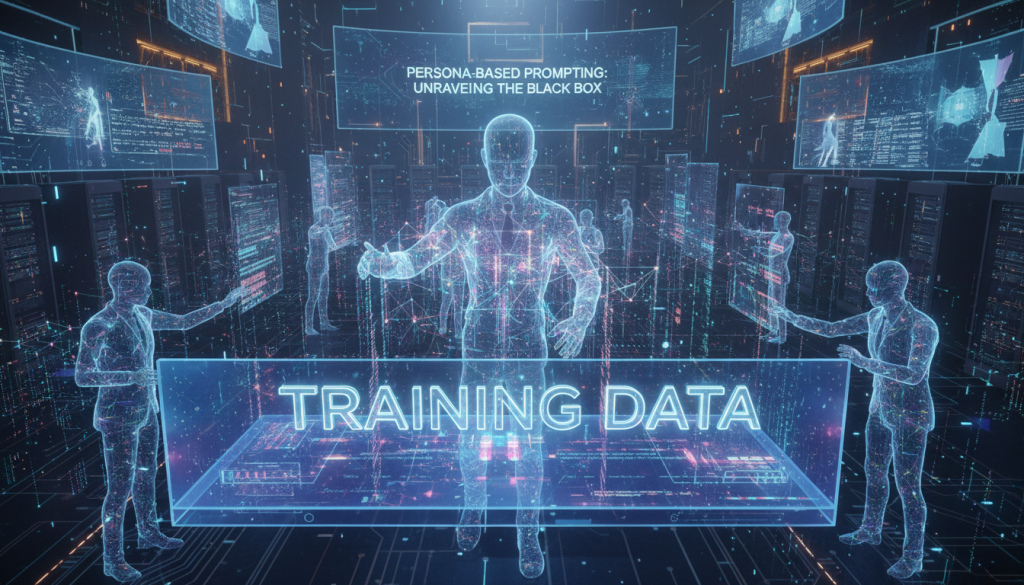
When a model adopts a confident persona, plausible-sounding errors become more convincing to users.
Expert persona trap: authoritative roles raise persuasive tone. An assistant may state wrong facts or invent citations while sounding certain. That happens because the underlying model pieces together patterns from training data, not verified sources.
Bias amplification: models can reflect stereotypes learned from data. Stereotyped roles risk unfair outcomes in hiring, support, or health guidance.
Variance and inconsistency: probabilistic generation means the same prompt can yield different outputs. That undermines policy-bound tasks and standardized reports.
Explainability gaps and realistic failures
Persona prompting changes behavior but does not explain why a token or claim appeared. Teams see fabricated citations, invented features, or unsafe code suggested confidently under a “senior” persona.
Mitigation preview
- Ground outputs with retrieval (RAG) and cite sources.
- Add refusal rules like “say you don’t know” and enforce templates.
- Run A/B tests and comparative evaluation before broad use.
Reminder: personas steer models for better style and consistency, but they are not guarantees of truth, fairness, or safety.
Risk, Compliance, and Trust: Using Personas Responsibly
Responsible persona design must pair role instructions with explicit privacy and approval rules to keep sensitive information out of prompts. Teams should document redaction rules and a “do not paste” list so employees avoid pasting private data into a prompt.
Privacy basics: never include unnecessary personal or proprietary data in prompts. Define automatic redaction steps and require escalation when prompts touch regulated information.
IP and copyright considerations
Organizations should review generated content before publication. Outputs can resemble copyrighted works or internal brand assets, so legal review and attribution checks matter.
Deepfakes and deception across media
Personas that create audio, video, or images can be misused for impersonation. Require consent, provenance metadata, and human approval before releasing synthetic media.
Detection and practical limits
- Watermarking and authentication help signal AI origin but are not foolproof.
- Classifier tools can detect manipulation but yield false positives and negatives.
- Combine multiple tools, logs, and human review to reduce risk.
Governance tip: treat persona definitions as control documents. Add mandatory disclaimers, prohibit regulated advice, and log outputs so the business can audit model use and restore trust.
Tooling and Deployment Considerations for Role-Prompted Systems
Deployment choices shape whether persona-driven assistants stay private, scale quickly, or add latency to workflows.
Smaller models can run locally for stronger privacy and IP protection, while large models usually operate in the cloud for capability and scale. Teams should map technology choices to legal, procurement, and data rules before rollout.
Local vs cloud: privacy, speed, and constraints
Local deployment reduces data exposure and supports offline work. Cloud services offer managed operations, faster updates, and GPU-backed throughput but add network latency and logging obligations.
Integrations and operational guidance
Embed role prompts into ticketing, CRM, document tools, and IDEs so users get consistent outputs where they already work. Store prompts in a versioned library with policy-reviewed role definitions and test cases.
- Account-level access control and telemetry for audits.
- Guard against prompt injection and require human approvals for high-impact tasks.
- Optimize prompt length: longer templates can raise token time and cost; prefer concise, outcome-focused prompts.
Advanced Role Prompting: From Single Personas to Agentic AI Systems
Agentic AI systems act like coordinated teams: they plan, call external tools, and iterate toward goals with minimal human steps.
What AI agents add: autonomy, tool use, and goal-driven behavior
An agent is a role-prompted program that can plan steps, call tools, and track progress toward an objective. It may query search, update spreadsheets, or create tickets as part of a workflow.
Practical impact: agents reduce repetitive work and let teams focus on judgment rather than orchestration.
Orchestrating multiple specialized roles for complex tasks
Agentic setups split responsibilities across personas: a planner outlines steps, a researcher gathers information, a writer drafts content, and a reviewer verifies outputs.
Orchestration patterns commonly include a coordinator that assigns tasks and specialist agents that produce and merge results into a single deliverable.
Designing safe tool-using personas with guardrails
Guardrails matter: tool-using personas require strict permissions, request logging, and explicit refusal rules to avoid unsafe actions and data leakage.
Evaluation must test tool-call correctness, data boundaries, and failure recovery, not just final output quality.
- Business use cases: an agentic marketing workflow drafts copy, checks brand compliance, and schedules posts.
- IT example: an IT agent triages tickets, runs diagnostics, and drafts recommended responses for human approval.
- Governance: audit logs, role-based access, and approval gates make autonomy auditable and safer.
Conclusion
Role prompting gives teams a practical lever to shape output style, risk posture, and task scope in real time.
Because large language models and other generative models learn patterns from training data, persona prompts steer behavior without retraining the underlying model. This makes role prompts an efficient path to better, more consistent content for business use cases.
Practically, teams should match persona to task and audience, define success criteria, add clear boundaries, and use reviewer or rubric roles to catch errors. Use retrieval or tuning when prompts alone cannot meet accuracy or compliance needs.
Responsible deployment requires privacy, IP checks, provenance, and controls for synthetic media. Treat persona definitions and prompt libraries as policy artifacts linked to audits and approvals.
Looking ahead, orchestrated multi-role and agentic setups will scale safe, consistent outputs as tools evolve across artificial intelligence and machine learning systems.
FAQ
What is role prompting and why does it change AI behavior?
Role prompting assigns a persona or role to a language model—such as “technical reviewer” or “marketing strategist”—so the model prioritizes relevant language, constraints, and decision rules. It reshapes tone, scope, and response structure by providing context cues that guide generation without retraining the model.
How does role prompting differ from standard prompts in natural language interactions?
Standard prompts ask for a task or information. Role prompting adds a defined identity and objectives for the model to emulate, which influences vocabulary, style, and the types of reasoning used. This reduces ambiguity and often yields more task-aligned outputs.
Why do personas affect what a model generates—tone, scope, and decisions?
Personas act as context that biases the model’s token predictions. By specifying voice, audience, and success criteria, prompts narrow the model’s output distribution, making responses more consistent with expectations for tone, level of detail, and allowed actions.
What are generative models and how do they create content?
Generative models—like large language models and diffusion models—learn statistical patterns from training data and produce new text, images, audio, or code by sampling from those learned distributions. They do not “know” facts in the human sense; they generate likely continuations based on patterns.
How does training data influence role prompting outcomes?
Training data supplies the patterns and representations the model uses to simulate roles. Prompts steer those patterns at inference time, but they do not teach new facts. The model’s existing biases and coverage in training data limit how accurately it can adopt specialized personas.
Where does role prompting fit into the model lifecycle—training, tuning, and generation?
Role prompting is an inference-time technique. It leverages behaviors shaped during pretraining and tuning (including RLHF) without changing model weights. Fine-tuning or retrieval can be layered with prompts when persistent, domain-specific performance is required.
Why do transformers and attention make role cues effective?
Transformers use attention to weight contextual tokens. When a prompt includes role cues early in the context window, the model treats them as high-priority signals, influencing subsequent token prediction and maintaining persona-consistent responses across the conversation.
How does instruction-following behavior interact with persona prompts?
Many modern models are tuned to follow instructions. Combining explicit role statements with clear, actionable instructions improves adherence to format, refusal conditions, and conversational continuity, making outputs more reliable for tasks.
How should one pick a persona to match task and user needs?
Choose roles that align with the required knowledge and audience: expert roles for technical accuracy, stakeholder roles for project relevance, and audience roles for tone. Define expected deliverables and constraints so the model can optimize for accuracy, creativity, speed, or consistency.
When should a persona include boundaries or refusal conditions?
Include boundaries whenever safety, privacy, legal, or ethical concerns exist—such as medical, legal, or personally identifiable data. Explicit refusal conditions reduce risky outputs and clarify what the model should not attempt.
What mechanisms explain why personas reduce irrelevant content and improve format adherence?
Personas act as constraint signals and context compressors: they limit the model’s search space and prioritize information relevant to the role. This reduces off-topic verboseness and improves adherence to required formats and templates.
How do role prompts help make outputs repeatable for business use?
Well-designed persona prompts lower variance by specifying style, structure, and acceptance criteria. That repeatability is essential for brand tone, consistent customer support, and compliance-heavy documents.
What prompt patterns consistently improve output quality?
Effective patterns include “You are a…” expert frames with domain terms, process roles that outline step-by-step reasoning, editor/reviewer roles for quality passes, rubric-driven roles for evaluation, and multi-role prompts that simulate collaborative workflows.
Can role prompting work for images, audio, and video as well as text?
Yes. Text-to-image prompts use art-director roles for style and composition. Audio prompts can specify voice actor traits, tone, and safety constraints. Video prompts benefit from scene, pacing, and storytelling roles that constrain visual storytelling.
How do role personas improve code generation and software workflows?
Developer personas—like “senior engineer” or “code reviewer”—steer models toward best practices, testing, and secure patterns. Distinct roles help with prototyping, refactoring, and catch insecure or overconfident explanations.
What business functions in U.S. organizations benefit most from role prompting?
Marketing, customer service, finance, operations, and research teams gain immediate value. Examples include tailored content briefs, consistent virtual agent replies, automated summaries for reports, and hypothesis generation with synthetic data support.
When are prompts enough, and when is fine-tuning or RLHF required?
Prompts suffice for many tasks where tone and structure matter. Fine-tuning or RLHF is needed when persistent domain knowledge, special safety behavior, or measurable improvements in correctness are required beyond what prompts can achieve.
How does retrieval-augmented generation (RAG) interact with personas?
RAG grounds persona outputs in current, transparent sources. Combining a role prompt with retrieved documents helps a persona provide accurate, source-cited answers rather than relying solely on memorized training data.
How should organizations evaluate whether a persona improves results?
Use quality dimensions such as coherence, relevance, accuracy, and style consistency. Run controlled A/B tests, iterate on prompt design, and apply rubrics to measure performance changes across representative inputs.
What are common failure modes of persona-based prompting?
Risks include authoritative-sounding hallucinations, bias amplification from training data, inconsistent outputs due to probabilistic sampling, and limited explainability when internal reasoning is opaque.
What compliance and trust concerns arise with personas?
Key concerns include handling sensitive data in prompts, respecting intellectual property, and preventing deceptive deepfakes in images, audio, or video. Organizations should adopt watermarking, content authentication, and realistic classifier limitations.
How do deployment choices (local vs cloud) affect role-prompted systems?
Local models offer stronger privacy and lower latency for sensitive use, while cloud models provide scale, up-to-date capabilities, and integration ease. Trade-offs include cost, maintenance, and compliance requirements.
How can multiple specialized roles be orchestrated for complex tasks?
Orchestration can chain personas—e.g., researcher, synthesizer, editor—so each role performs a distinct subtask. This agentic approach improves specialization, but requires guardrails to ensure consistency and safe tool use.
What should teams watch for when designing tool-using personas?
Design guardrails for tool permissions, define failure and refusal behaviors, log decisions for audit, and test interactions under adversarial inputs to prevent harmful or unauthorized actions.